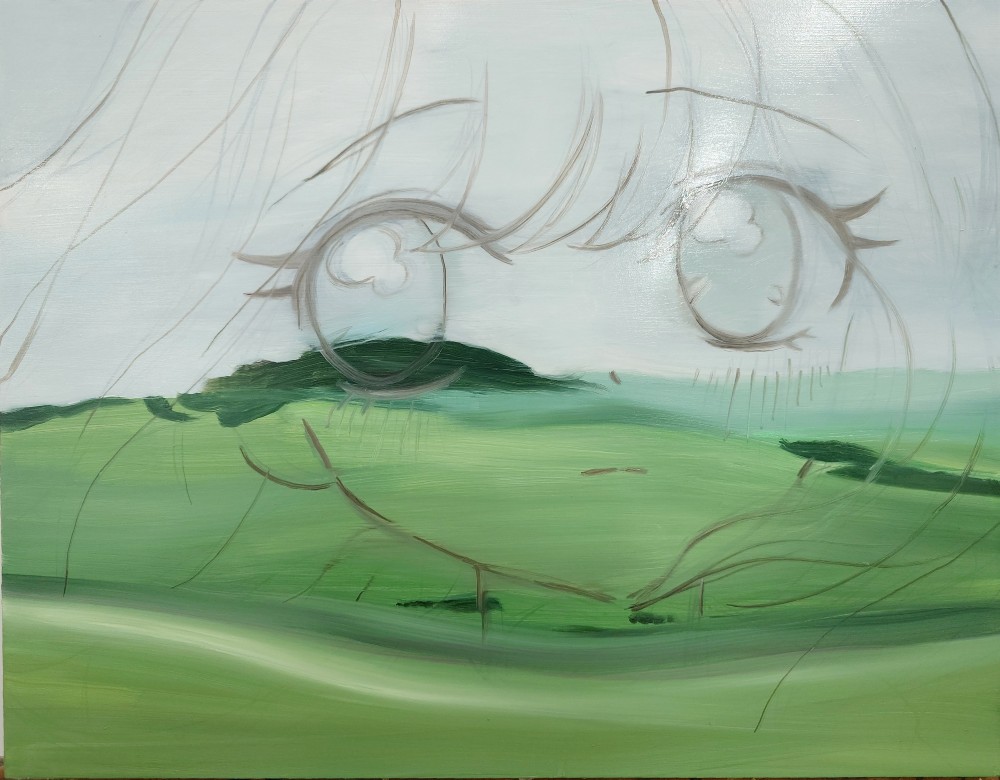
- Stacking/2026
HAYATO HANABUSA
英颯斗
- ART FAIR - MEET YOUR ARTISTS -CO-CROSSOVER -Romantic beyond us (earth)-
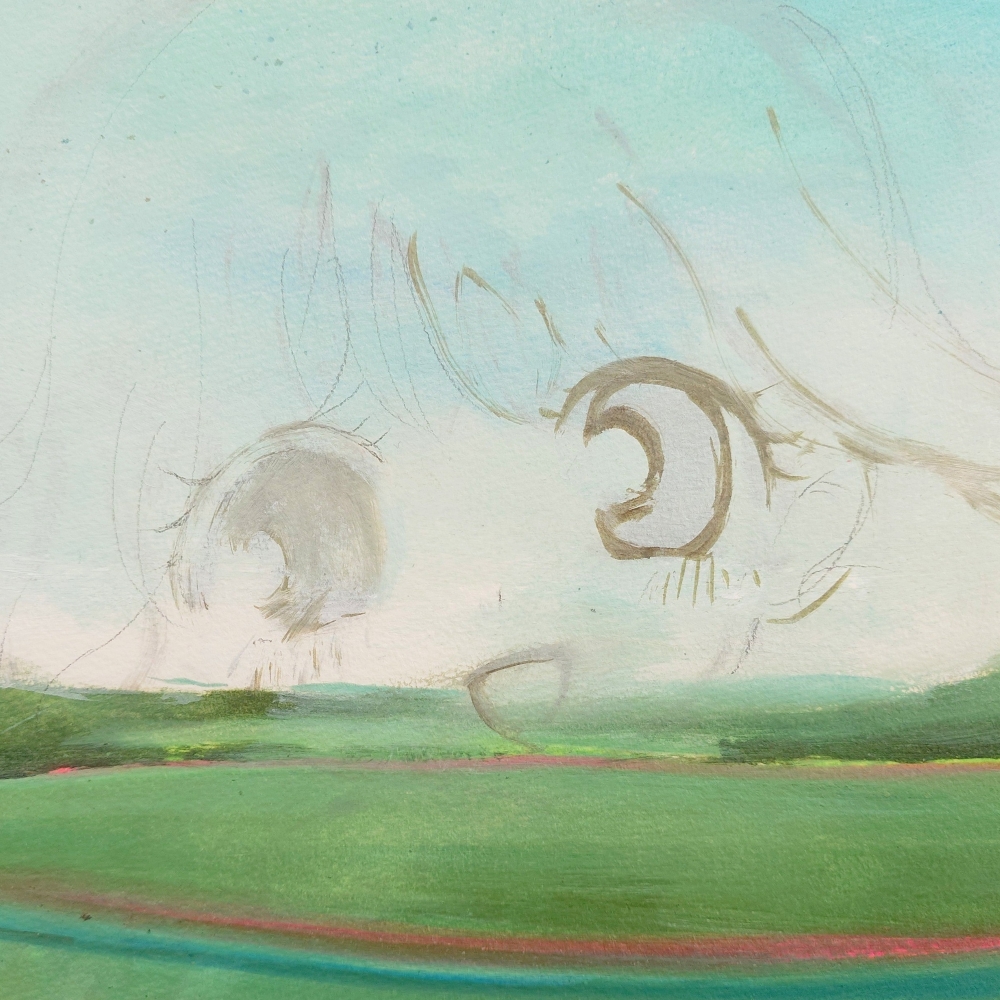
The work depicts the process by which the contours of the body unravel in memory, as landscapes and faces are superimposed, and then emerge as a different image.
Raised by a mother who was a shojo manga artist, manga-style lines and faces were a part of her daily life from a young age. Rather than directly referencing them, she treats them as lines that have been transformed through the anime and illustrations she has encountered throughout her life, as well as her own drawing habits and tendencies. The faces that appear in her works are closer to the traces of a body that temporarily remain on the surface of memory, rather than characters with clearly defined personalities.
On the other hand, he is also interested in the vast horizons, farmlands, and waterside landscapes he became familiar with in Hokkaido, as well as spaces that are not fully imprinted in his memory. On screen, these landscapes appear not merely as backgrounds, but as something that encroaches on the contours of the face and reshapes the body into a different form.
In her recent work "Stacking," she explores the process by which the characters' bodies are re-remembered as part of the landscape, while questioning where the cartoon-like lines come from, what they pass through, and why they appear in the current landscape.
Eisato_CV
Raised by a mother who was a shojo manga artist, manga-style lines and faces were a part of her daily life from a young age. Rather than directly referencing them, she treats them as lines that have been transformed through the anime and illustrations she has encountered throughout her life, as well as her own drawing habits and tendencies. The faces that appear in her works are closer to the traces of a body that temporarily remain on the surface of memory, rather than characters with clearly defined personalities.
On the other hand, he is also interested in the vast horizons, farmlands, and waterside landscapes he became familiar with in Hokkaido, as well as spaces that are not fully imprinted in his memory. On screen, these landscapes appear not merely as backgrounds, but as something that encroaches on the contours of the face and reshapes the body into a different form.
In her recent work "Stacking," she explores the process by which the characters' bodies are re-remembered as part of the landscape, while questioning where the cartoon-like lines come from, what they pass through, and why they appear in the current landscape.
Eisato_CV

