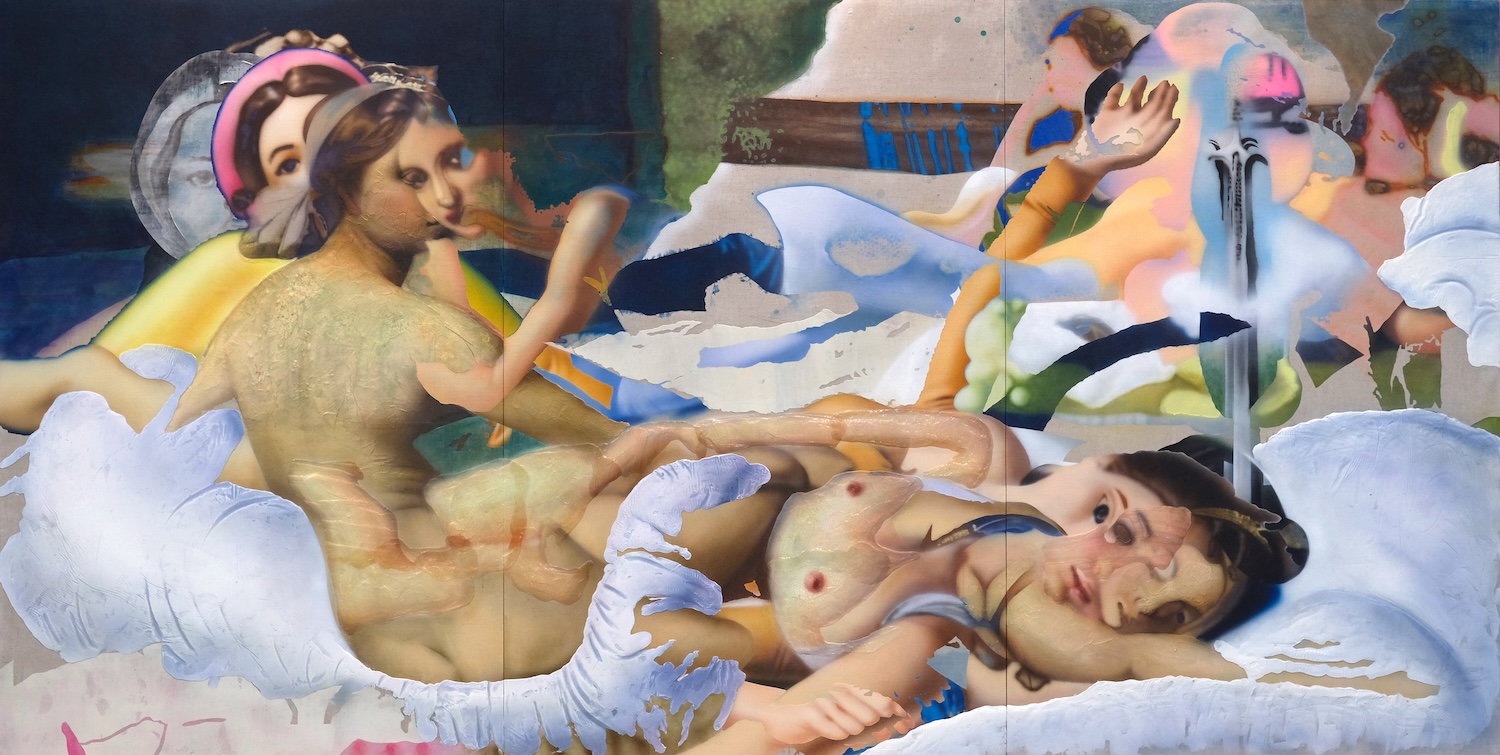
- 横たわる象/Reclining Figure 2025
Lea Embeli
Lea Embeli
- ART FAIR - MEET YOUR ARTISTS -CO-CROSSOVER -Romantic beyond us (earth)-

Rare Enveri is a painter and interdisciplinary artist who explores the intersection of art history, artificial intelligence, and gender bias.
Her work collages classic art visuals with AI-generated visuals, highlighting the biases lurking in traditional art forms and contemporary digital culture and media. Emveri's practice questions how technology reproduces and reinforces historical prejudices against the female body, and why new media continue to return to stereotypical patterns of objectification across all eras.
Referencing classical artworks such as the elongated odalisk of Ingres, she dismantles the prejudices inherent in art history and explores how AI and historical art strive to align the female body with ideals of beauty. She argues that these aesthetic ideals are not only harmful but also utterly unattainable. Emberi incorporates AI-generated distortions and glitches into paintings and sculptures, creating fluid and ambiguous forms that transcend traditional gender bias. These deconstructed figures lack fixed Identity, becoming free canvases for interpretation and promoting a broader space for self-reflection.
By blending historical motifs of art with the aesthetics of artificial bodies, Emberi seeks to prompt viewers to reconsider their perceptions of gender, technology, and their future. Her works have been exhibited internationally, with significant presentations in Serbia and Japan. In March 2025, she earned her master's degree from Tokyo University of the Arts and continues her creative work, striving to sustain herself in the constantly hostile digital space.
Profile image: Photo by Takehide Niitsubo
Lea Embeli is a pain ter and interdisciplinary artist whose work explores the intersection of art history, artificial intelligence, and gender bias. Through pain ting that collages AI-generated visuals of classical art pieces, she explores the biases embedded in both traditional art forms and contemporary digital culture and media. Her practice investigates how technology replicates and reinforces historically biased depictions of the female body, questioning why new mediums continually return to familiar patterns of objectification.
By referencing classical artworks, such as Ingres’ elongated odalisque, she attempts to deconstruct the inherent biases in art history. She draws a parallel between AI and art history, both of which alter the female body to adhere to beauty ideals, which are not only damaging but impossible to reach. She incorporates AI distortions and glitches into her pain tings and sculptures, creating fluid, ambiguous forms that transcend conventional gender binaries. These deconstructed figures, stripped of fixed identity, serve as open canvases for interpretation, promoting a more inclusive space for self-reflection.
By blending art-historical motifs with the aesthetics of artificial bodies, she invites viewers to reconsider their perceptions of gender, technology, and the future of both. Embeli’s work has been presented internationally, with significant exhibitions in Serbia and Japan. She completed her degree with an MA from the Tokyo University of the Arts in March 2025, and she continues to pursue her artistic practice while navigating the challenges of a persistently hostile digital landscape.
Profile credit:Photo by Shintsubo Kenshu
LeaEmbeli_CV(JP)
LeaEmbeli_CV(EN)
Her work collages classic art visuals with AI-generated visuals, highlighting the biases lurking in traditional art forms and contemporary digital culture and media. Emveri's practice questions how technology reproduces and reinforces historical prejudices against the female body, and why new media continue to return to stereotypical patterns of objectification across all eras.
Referencing classical artworks such as the elongated odalisk of Ingres, she dismantles the prejudices inherent in art history and explores how AI and historical art strive to align the female body with ideals of beauty. She argues that these aesthetic ideals are not only harmful but also utterly unattainable. Emberi incorporates AI-generated distortions and glitches into paintings and sculptures, creating fluid and ambiguous forms that transcend traditional gender bias. These deconstructed figures lack fixed Identity, becoming free canvases for interpretation and promoting a broader space for self-reflection.
By blending historical motifs of art with the aesthetics of artificial bodies, Emberi seeks to prompt viewers to reconsider their perceptions of gender, technology, and their future. Her works have been exhibited internationally, with significant presentations in Serbia and Japan. In March 2025, she earned her master's degree from Tokyo University of the Arts and continues her creative work, striving to sustain herself in the constantly hostile digital space.
Profile image: Photo by Takehide Niitsubo
Lea Embeli is a pain ter and interdisciplinary artist whose work explores the intersection of art history, artificial intelligence, and gender bias. Through pain ting that collages AI-generated visuals of classical art pieces, she explores the biases embedded in both traditional art forms and contemporary digital culture and media. Her practice investigates how technology replicates and reinforces historically biased depictions of the female body, questioning why new mediums continually return to familiar patterns of objectification.
By referencing classical artworks, such as Ingres’ elongated odalisque, she attempts to deconstruct the inherent biases in art history. She draws a parallel between AI and art history, both of which alter the female body to adhere to beauty ideals, which are not only damaging but impossible to reach. She incorporates AI distortions and glitches into her pain tings and sculptures, creating fluid, ambiguous forms that transcend conventional gender binaries. These deconstructed figures, stripped of fixed identity, serve as open canvases for interpretation, promoting a more inclusive space for self-reflection.
By blending art-historical motifs with the aesthetics of artificial bodies, she invites viewers to reconsider their perceptions of gender, technology, and the future of both. Embeli’s work has been presented internationally, with significant exhibitions in Serbia and Japan. She completed her degree with an MA from the Tokyo University of the Arts in March 2025, and she continues to pursue her artistic practice while navigating the challenges of a persistently hostile digital landscape.
Profile credit:Photo by Shintsubo Kenshu
LeaEmbeli_CV(JP)
LeaEmbeli_CV(EN)

